Average Reviews:

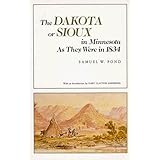
(More customer reviews)Are you looking to buy The Dakota or Sioux in Minnesota as They Were in 1834 (Borealis Books)? Here is the right place to find the great deals. we can offer discounts of up to 90% on The Dakota or Sioux in Minnesota as They Were in 1834 (Borealis Books). Check out the link below:
>> Click Here to See Compare Prices and Get the Best Offers
The Dakota or Sioux in Minnesota as They Were in 1834 (Borealis Books) ReviewOn Lake Calhoun in Minneapolis there is a large rock with a heavily patinated plaque imbedded in it right under an impressive gold-domed church. The plaque is extremely weathered and greenish, and looks as if it has been reset more than once into the rock. It says that, above the rock on the hill, where the present day church now stands, is the original site of the first dwelling built in Minneapolis in 1834 by Samuel and Gideon Pond. I've walked by this historic marker for years while circling the lake, so when I came across Samuel Pond's work on the Dakota in Minnesota (including those that lived on Lake Calhoun), I had to read it.Obviously, the salient thing about Lake Calhoun is the complete absence or even a tiny minute speck of evidence that it was once inhabited by Native Americans. They are simply gone without a trace. High rises and expensive homes now line the lake, and ice fishers speckle its icy surface from approximately October to February. From the viewpoint of today, it's almost impossible to believe Lake Calhoun was any different. That's only one thing that makes this book so great. It makes the reader aware of what was happening before the europeans arrived (or invaded as some people see it) in Minnesota.
The book was written by a missionary; Samuel Pond's sole purpose in habitating with the Dakota was to save souls. The somewhat happy and possibly unforeseen outcome of this was that Pond had to get to know these people incredibly unbelievably well to "save" them. So, as good missionaries will do, he literally shacked up with them. He hunted with them, observed rituals, went on long journeys with them, spoke their language fluently, and, most importantly, talked with them. This guy was there, he wasn't a journalist or a muckraker. He was literally on a mission.
The book, almost paradoxically, does not mention whether or not Pond was successful in "converting" or "saving" the Dakota. There is almost no mention whatsoever of his missionary work, so this is not a self-gratuitous work that shouts "look what I did!" What it is is an observance, a capturing of a people before that people completely disappeared (i.e., as they have today).
It is important to note that the book was not written while Pond lived with the Dakota. It was written some thirty or forty years after. Why? When Pond lived with the Dakota, there was no indication that within the next fifty years Native American culture would be more or less wiped out. As Pond observed this phenomenon, he found it best to write down his recollections of his life with the Dakota, since the culture no longer existed as it was in the 1830s. Pond wrote after what is now known as the Dakota Conflict of 1862, which radically changed the relations between whites and Dakota in the Upper Midwest, and resulted in the largest mass execution in United States History (in Mankato, Minnesota; Reconciliation Square now marks the spot where 38 Dakota were simultaneously hung by the neck for their supposed part in the events of 1862).
Pond is mostly very fair to the Dakota. He passionately defends them against what were the then mainstream accusations of laziness, uncleanliness, gluttony, and barbarity. Pond was overall very impressed by the Dakotas, and obviously had a lot of respect for them as a people. He is, however, not fair to the Dakota's religious practices - this is the one topic where Pond's ulterior motives really show - calling them "ridiculous superstitions".
All in all, Pond's descriptions and retelling of events are priceless for anyone curious about Dakota life before the overwhelming influence of european settlers set in. There are so many amazing stories winding throughout this text that picking one or two out as examples would be unjust to the rest. Pond also draws parallels between the life of european settlers of the time and of the Dakota. These are always fascinating, and Pond's intent seems to be making europeans think hard about their prejudices.
Why this book is not more widely read or talked about I'm at a loss to explain. Perhaps the missionary twist scares people off? Whatever the reason this book is vitally important in that it attempts to capture the culture that was completely destroyed in the 19th century. It is timely, of course, in that the Dakota are often referred to as "savages" or "heathens", but that adds a historical interest to the text, albeit a somewhat now sad one. One must prepare oneself for a 19th century read when dipping into this book. It is well worth the effort.
Lastly, this book has been reissued as "Dakota Life in the Upper Midwest" which is somewhat strange since the author intended the title to emphasize that the work focused on "how they were" in 1834. The title change is likely attributable to the word "Sioux" which is a derogatory word that translates as "Snake". Nonetheless, the new title detracts from the work, and removes a certain historicity from it. The original title should be restored for historical accuracy and perspective.The Dakota or Sioux in Minnesota as They Were in 1834 (Borealis Books) Overview
Want to learn more information about The Dakota or Sioux in Minnesota as They Were in 1834 (Borealis Books)?
>> Click Here to See All Customer Reviews & Ratings Now

0 comments:
Post a Comment